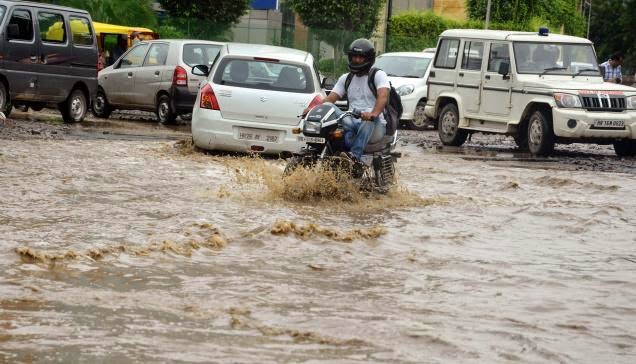
The landscape especially in urban area is predominantly impervious and do not allow rain water to seep into the soil level. Buildings, roads, parking areas, pavements and other such structures cover the soil level with layers of concrete making them unable to absorb storm water. This also leads to excessive soil erosion in case of urban flooding. Sewage system gets choked as flash flooding occurs in urban regions. Moreover, apart from losses due to these, the greatest loss is that of wastage of water. In some of the regions where clean drinking water is scares, storm water can fill in the requirement but it is not possible unless it is managed properly and channelized for daily needs.
Among several ways that are normally used to manage storm water, the best and most economic way is that of rain water harvesting. Storm water, is accumulated precipitation during the rainfall, which does not find any ground suitable to seep in. In case of urban area, the total surface area that contribute to storm water is very large and thus the amount of storm water is also too much. All these water, either go into the drain and get wasted or flows out of the urban region and end up unutilized. Then to use this water it is required that either urban area is designed in a way that rain water finds soil surface to seep in or the rain water is directly collected and used as required.

The former method is costly and more often than not, it is also quite impractical. The reason being, it is not possible to remodel an already existing urban space. Even if it is envisioned, the cost of the same will run into unimaginable figures. However, for a limited space, such as societies, specific building and other such area, measures such as use of grassed swales, bioretention cells and green parking design could be used effectively and economically. But for the larger scenario, the best method is to use rain water harvesting.

In this method, the rain water is collected as it precipitates on impervious surfaces. The collected water is channelized to a storage tank. It is then filtered and treated, if required, and then supplied back to for usage. Moreover, another added advantage is that the whole setup is highly economical and lasts for years without involving any major maintenance cost. The system of rain water harvesting can be installed anywhere as most of its mechanism can be fitted underground. Even the storage tanks can be well placed below the ground; thereby, not hindering the aesthetics of the place.

Large playgrounds, community space, parks, even pavement areas can be suitably used for the purpose of water storage through rain water harvesting. Moreover, this system is also used successfully in rural area that has got short supply of ground water. In such areas, the system of rain water harvesting is installed beneath the barren land and rain water is collected in the tanks. The water, is then utilized for irrigation and thus do not require filtering or any sort of treatment. This saves a lot of cost to the farmers and also provides them with a reliable source of water for irrigation.
Among several ways that are normally used to manage storm water, the best and most economic way is that of rain water harvesting. Storm water, is accumulated precipitation during the rainfall, which does not find any ground suitable to seep in. In case of urban area, the total surface area that contribute to storm water is very large and thus the amount of storm water is also too much. All these water, either go into the drain and get wasted or flows out of the urban region and end up unutilized. Then to use this water it is required that either urban area is designed in a way that rain water finds soil surface to seep in or the rain water is directly collected and used as required.
The former method is costly and more often than not, it is also quite impractical. The reason being, it is not possible to remodel an already existing urban space. Even if it is envisioned, the cost of the same will run into unimaginable figures. However, for a limited space, such as societies, specific building and other such area, measures such as use of grassed swales, bioretention cells and green parking design could be used effectively and economically. But for the larger scenario, the best method is to use rain water harvesting.
In this method, the rain water is collected as it precipitates on impervious surfaces. The collected water is channelized to a storage tank. It is then filtered and treated, if required, and then supplied back to for usage. Moreover, another added advantage is that the whole setup is highly economical and lasts for years without involving any major maintenance cost. The system of rain water harvesting can be installed anywhere as most of its mechanism can be fitted underground. Even the storage tanks can be well placed below the ground; thereby, not hindering the aesthetics of the place.
Large playgrounds, community space, parks, even pavement areas can be suitably used for the purpose of water storage through rain water harvesting. Moreover, this system is also used successfully in rural area that has got short supply of ground water. In such areas, the system of rain water harvesting is installed beneath the barren land and rain water is collected in the tanks. The water, is then utilized for irrigation and thus do not require filtering or any sort of treatment. This saves a lot of cost to the farmers and also provides them with a reliable source of water for irrigation.


